

Giáo án Tiếng Anh Lớp 6 - Tuần 10 - Nguyễn Tuấn - Năm học 2020-2021
- Notice how to conjugate ordinary verb in the simple present tense especially the third singular person.
- Call them work in pairs, ask and answer about Nga’s daily activities.
- Move around to help the weaker pairs.
- Some pairs perform in front of the class.
 9 trang
17/04/2024
1620
9 trang
17/04/2024
1620
Bạn đang xem tài liệu "Giáo án Tiếng Anh Lớp 6 - Tuần 10 - Nguyễn Tuấn - Năm học 2020-2021", để tải tài liệu gốc về máy hãy click vào nút Download ở trên.
Tóm tắt nội dung tài liệu: Giáo án Tiếng Anh Lớp 6 - Tuần 10 - Nguyễn Tuấn - Năm học 2020-2021
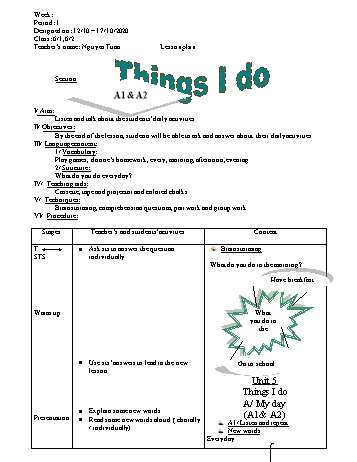
Week:
Period: 1
Designed on: 12/10 – 17/10/2020
Class: 6/1, 6/2
Teacher’s name: Nguyen Tuan	Lesson plan
A1 & A2
	Section
I/ Aim:
	Listen and talk about the students’ daily activities.
II/ Objectives:
	By the end of the lesson, students will be able to ask and answer about their daily activities.
III/ Language content:
	1/ Vocabulary:
	Play games, do one’s homework, every, morning, afternoon, evening
	2/ Structure:
	What do you do everyday?
IV/. Teaching aids:
	Cassette, tape and projector and colored chalks.
V/. Techniques:
	Brainstorming, comprehension questions, pair work and group work.
VI/. Procedure:
Stages
Teacher’s and students’ activities

Content
T
STS
Warm up
Presentation
Practice
Production
Homework

Ask sts to answer the question individually.
Use sts’ answers to lead in the new lesson.
Explain some new words.
Read some new words aloud. ( chorally / individually)
Ask sts to work in groups , look at the list what Nga does every day and then guess which activities she does.
Get feedback .
Call them to listen to the tape carefully and then check their prediction.
Notice how to conjugate ordinary verb in the simple present tense especially the third singular person.
Call them work in pairs, ask and answer about Nga’s daily activities.
Move around to help the weaker pairs.
Some pairs perform in front of the class.
Ask sts to work in pairs, ask and answer about their daily activities. ( open pairs/ closed pairs)
Have them rewrite what they do everyday about four sentences.
Prepare some new words in A3& A4 for the next period.
Prepare two sheets of transparent film to check up and write the answer.
Brainstorming
What do you do in the morning?
Have breakfast
What you do in the morning
Go to school
Unit 5
Things I do
A/ My day
(A1& A2)
A1/ Listen and repeat
New words
Everyday
Morning
Afternoon translation
Evening
Play games
Do one’s homework
Task 1
Guess and tick (P) what Nga does everyday.
Activities
Guess
Answer key
1/ get up at 6.


P
2/ have breakfast


3/ get dressed


4/ go to school.


P
5/ play games


P
6/ do her homework

P

C2/ Comprehension questions
1/ What does Nga do everyday?
2/ What does she do every morning?
3/ What does she do every afternoon?
4/ What does she do every evening?
Answer key
1/ She gets up at six.
2/ She goes to school.
3/ She plays games.
4/ She does her homework.
Free practice
What do you do everyday?
What do you do every morning?
What do you do every afternoon?
What do you do every evening?
Week: 6
Period: 2
Designed on: 12/10 – 17/10/2020
Class: 6/1, 6/2
Teacher’s name: Nguyen Tuan	Lesson plan
Unit 5
	Section
A3 & A4
I/ Aim:
	Listen and talk about the students’ free time after school.
II/ Objectives:
	By the end of the lesson, students will be able to ask and answer about their free time after school.
III/ Language content:
	1/ Vocabulary:
	Watch, television, do , housework, listen to, music, read
	2/ Structure:
	What do you do after school?
IV/. Teaching aids:
	Cassette, tape and projector and colored chalks.
V/. Techniques:
	Chatting, comprehension questions, pair work and group work.
VI/. Procedure:
Stages
Teacher’s and students’ activities
Content

T
STS
Warm up
Presentation
Practice
Production
Homework

Call sts to answer some questions individually.
Ask them to work in groups , match the words in column A to the Vietnamese translation in column B.
Get feedback and correct.
Peer correction.
Explain some new words.
Have sts read aloud after the teacher. ( chorally/ individually)
Call sts to work in groups, fill in the gaps with the given words in the box by guessing.
Have them listen to the tape carefully and then check their prediction.
Have them work in pairs, practice the dialogue.
Ask sts to look at the pictures and answer some questions about what they do after school. (Pair work)
Some pairs perform in front of the class.
Notice how to conjugate ordinary verb in the simple present tense especially the third singular person.
Ask them to work in pairs, ask and answer about what they do after school.
Learn new words by heart.
Prepare some new words in A5 & A6 for the next period.
Prepare a sheet of transparent film to check up.

Chatting
1/ Do you get up at six everyday?
2/ Do you go to school in the morning?
Matching
A
B
1/ Go to school
a/ thức dậy
2/ Play games
b/ đi học
3/ Get up
c/ ăn sáng
4/ Have breakfast
d/ chơi trò chơi
Answer key
1 / - b
2/ - d
3/ - a
4/ - c
Unit 5
Things I do
( A3 & A4)
A3/ Listen and repeat
New words
Watch television
Do the housework translation
Listen to music
Read
Task 1
Fill in the gaps with the words in the box
read, housework, watch, music
1/ I  television.
2/ I do the . .
3/ I listen to  .
4/ I  .
Guess
Answer key
1/
watch
2/
housework
3/
music
4/
read

A4/ Comprehension questions
1/ What does Lan do after school?
2/ What does Ba do after school?
3/ What does Thu do after school?
4/ What does Nam do after school?
Answer key
1/ She does the housework.
2/ He watches television.
3/ She reads.
4/ He listens to music.
Free practice
What do you do after school?

Unit 5
A5 & A6
	Section
I/ Aim:
	Listen and ask whether the students do the activities or not.
II/ Objectives:
	By the end of the lesson, students will be able to ask whether they do some questions or not and they answer agree or are against .
III/ Language content:
	1/ Vocabulary:
	Volley ball, soccer
	2/ Structure:
	Do you play soccer?
 Yes, I do. / No, I don’t.
IV/. Teaching aids:
	Cassette, tape and projector and colored chalks.
V/. Techniques:
	Brainstorming, comprehension questions, pair work and group work.
VI/. Procedure:
Stages

Teacher’s and students’ activities
Content
T
STS
Warm up
Presentation
Practice
Production
Homework

Ask sts to work in pairs, match the pictures in column A with the words in column B.
Get feedback and correct.
Explain some key words.
Read some key words aloud. ( individually / chorally)
Call them to work in pairs and guess which games they play.
Call them to listen to the tape carefully and then check their prediction.
Have them work in pairs, practice about the dialogue.
Some pairs perform the dialogue in front of the class.
Correct sts’ mistakes if there are any.
Call sts to listen to the tape in order to recognize the intonation of Yes- No questions.
Have them work in pairs and answer using their own words.
Call some pairs perform in front of the class.
Have them write all exercises in their notebooks.
Translate the dialogue into Vietnamese.
Learn some key words by heart.
Prepare some new words in B1- B3 for the next period.
Matching
A
B

a/

1/ Read

b/

2/ Have breakfast

c/

3/ Play soccer

d/

4/ Do one’s homework.
Answer key
4
1
2
3
Unit 5 :Things I do
( A5 & A6)
A5/ Listen and repeat
Key words
Play volley ball pictures
Play soccer
After
Task 1
Listen and then guess which games they play
Guess
Answer key
1/ play volley ball


P
2/ play tennis


3/ listen to music


4/ play soccer


P

Task 2
Practice the dialogue with a partner
A6/ Listen and answer
Activities
Yes, I do
No, I don’t
1/ Do you play sports?


2/ Do you watch television?


3/ Do you do the housework?


4/ Do you play volleyball?


5/ Do you listen to music?


6/ Do you read?


7/ Do you do your homework?


Drawing experience:
- - Hs nói được các thói quen hàng ngày và thời gian rảnh.
- Hs chia thì hiện tại đơn tốt.
Week: 6
Period: 3
Designed on: 12/10 – 17/10/2020
Class: 6/1, 6/2
Unit 5
Teacher’s name: Nguyen Tuan	Lesson plan
	Section
B1 – B3
I/ Aim:
	Reading the pictures for details .
II/ Objectives:
	By the end of the lesson, students will be able to tell about their routine as well as the time they do their daily activities.
III/ Language content:
	1/ Vocabulary:
	Eat, a quarter, go to bed, go home, have classes, have lunch
	2/ Structure:
	What time do you get up?
IV/. Teaching aids:
	Cassette, tape and projector and colored chalks.
V/. Techniques:
	Brainstorming, comprehension questions, pair work and group work.
VI/. Procedure:
Stages
Teacher’s and students’ activities
Content

T STS
Warm up
Presentation
Practice
Production
Homework

Ask sts to answer the questions individually.
Get feedback and correct.
Use the sts’ answers to lead in the new lesson.
Read some new words aloud. ( chorally / individually)
Ask sts to work in groups , guess and answer some questions about Ba’s daily activities.
Get feedback.
Call them to read the passage in silence and then check their prediction.
Have them read the passage after the teacher.
Call them to work in pairs, practice about the passage.
Some sts read the passage in front of the class.
Correct sts’ mistakes if there are any.
Ask them to work in groups, read the passage again and then complete the table.
Get feedback and correct by using projector.
Peer correction.
Have them work in groups, answer the given questions.
Correct by using projector.
Have them work in pairs, practice about the questions.
Some pairs perform before the class.
Ask them to work in groups, write a passage about their daily activities.
A student from each group perform in front of the class.
Have them rewrite their daily activities in their notebooks.
Learn new words by heart.
Prepare some new words in C1 for the next period.
Prepare a sheet of transparent film to check up.
Brainstorming
What do you often do everyday? And what time?
Get up at 5. /at 6.
What you do everyday and what time
Have lunch at 11:20./ at 12; 20
Suggested answers
Have lunch at 11:20
Go to school at 12: 35
Play soccer at 5:00 pm
Go to bed at 8:30 pm.
Unit 5 :Things I do.
( B1- B3)
B/ My routine
B1/ Read
New words
A quarter past eleven = eleven fifteen
A quarter to seven = six forty five
Eat (v)
Go home (v) Mime
Go to bed (v)
Task 1
Open questions
1/ What does Ba do everyday? And what time?
Suggested answers
Get up at 7
Wash his face at 7:10
Go to school at 12:30
Do his homework at 7pm
Go to bed at 10 pm.
Task 2 Reading
B2/ Complete the table.
Actions
Time

Ba
Me
Get up


Go to school


Classes start


Classes finish


Have lunch


Go home


Go to bed


Answer key
Actions
Time

Ba
Me
Get up
6:00

Go to school
6:45

Classes start
7:00

Classes finish
11:15

Have lunch
11:30

Go home
5:00

Go to bed
10:00


B3/ Practice with a partner
1/ What time does Ba get up?
2/ What time does Ba go to school?
3/ What time does Ba have classes?
4/ What time does Ba have lunch?
5/ What time does Ba go home?
6/ What time does Ba go to bed?
Free practice
Write it up
Write a paragraph about your daily activities
Suggested questions
1/ What time do you get up?
2/ What time do you have breakfast?
3/ What time do you go to school?
4/ What time do you play soccer?
5/ What time do you do your homework?
6/ What time do you go to bed?
Drawing experience:
- Hs nói được các thói quen hàng ngày và thời gian rảnh.
- Hs chia thì hiện tại đơn tốt.
File đính kèm:
- giao_an_tieng_anh_lop_6_tuan_10_nguyen_tuan_nam_hoc_2020_202.docx


