

Giáo án Tiếng Anh Lớp 7 - Tuần 12 - Võ Kim Trí - Năm học 2020-2021
1. Divide class into group of 4.
2. Have students listen to the music in movies. (Film: 1. Brave, 2: Despicable me, 3:
Transformer, 4: Fast and Furious, 5: Annabell,6: Romeo and Juliet)
3. When the group has 1 correct answer give them 1 point.
4. The winners are the first group to get the most points.
 7 trang
19/04/2024
2780
7 trang
19/04/2024
2780
Bạn đang xem tài liệu "Giáo án Tiếng Anh Lớp 7 - Tuần 12 - Võ Kim Trí - Năm học 2020-2021", để tải tài liệu gốc về máy hãy click vào nút Download ở trên.
Tóm tắt nội dung tài liệu: Giáo án Tiếng Anh Lớp 7 - Tuần 12 - Võ Kim Trí - Năm học 2020-2021
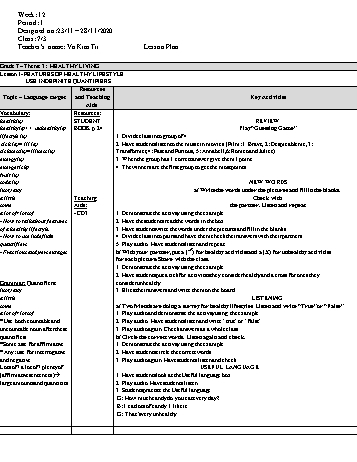
Week: 12
Period: 1
Designed on: 23/11 – 28/11/2020
Class: 7/3
Teacher’s name: Vo Kim Tri 	Lesson Plan
Grade 7 – Theme 3: HEALTHY LIVING
Lesson 1- FEATURES OF HEALTHY LIFESTYLE
 USE INDEFINITE QUANTIFIERS
Topic – Language target
Resources and Teaching Aids
Key Activities
Vocabulary:
health (n)
healthy(a) >< unhealthy(a)
lifestyle (n)
 sick (a)= ill (a)
sickness(n)= illness (n)
energy (n)
energetic(a)
fruit (n)
soda (n)
(not) any
a little
some
a lot of/ lots of
- How to talk about features of a healthy lifestyle.
- How to use indefinite quantifiers.
- Fractions and percentages
Grammar: Quantifiers:
(not) any
a little
some
a lot of/ lots of
* Use both countable and uncountable noun after these quantifiers.
*Some: use for affirmative.
* Any: use for interrogative and negative.
Lots of / a lot of / plenty of (affirmative sentences )à large amounts and quantities

Resources:
STUDENT BOOK p.24
Teaching Aids:
- CD3
REVIEW
Play “Guessing Game”
1. Divide class into group of 4.
2. Have students listen to the music in movies. (Film: 1. Brave, 2: Despicable me, 3:
Transformer, 4: Fast and Furious, 5: Annabell,6: Romeo and Juliet)
3. When the group has 1 correct answer give them 1 point.
4. The winners are the first group to get the most points.
 NEW WORDS
a/ Write the words under the pictures and fill in the blanks.
Check with
 the partner. Listen and repeat.
1. Demonstrate the activity using the example.
2. Have the students read the words in the box
3. Have students write the words under the pictures and fill in the blanks.
4. Divide class into pairs and have them check their answers with their partners.
5. Play audio. Have students listen and repeat.
b/ With your partner, put a (ü) for healthy activities and a (X) for unhealthy activities
for each picture. Share with the class.
1. Demonstrate the activity using the example.
2. Have students put a tick for activities they consider healthy and a cross for ones they
consider unhealthy.
3. Elicit their answers and write them on the board.
LISTENING
a/ Two friends are doing a survey for healthy lifestyles. Listen and write “True” or “False”
1. Play audio and demonstrate the activity using the example.
2. Play audio. Have students listen and write “true” or “false”
3. Play audio again. Check answers as a whole class.
b/ Circle the correct words. Listen again and check.
1. Demonstrate the activity using the example.
2. Have students circle the correct words.
3. Play audio again. Have students listen and check.
	USEFUL LANGUAGE
1. Have students look at the Useful language box.
2. Play audio. Have students listen.
3. Students practice the Useful language.
 G: How much candy do you eat every day?
 B: I eat lots of candy. I like it.
 G: That’s very unhealthy.
Grade 7 – Theme 3: HEALTHY LIVING Pe
Lesson 1- FEATURES OF HEALTHY LIFESTYLE
 USE INDEFINITE QUANTIFIERS
Topic – Language target
Resources and Teaching Aids
Key Activities
Grammar:
Many/ much: + (negative sentences)à small (or smaller than expected) quantities or amounts.
 + (questions) à to ask about quantities or amounts.
Structure:
G: How much exercise do you do every week?
 B: I do a lot of exercise every week.
 G: That’s very healthy.

Resources:
STUDENT BOOK p.5
Teaching Aids:
- CD5
 REVIEW
Complete the sentences with lots of/a lot of, many, much
We didn’t spend  money.
There’s no need to hurry. We’ve got  time.
Sue drinks  tea.
Do you take  pictures on your vacations?
He doesn’t know  people in this town.
He is very popular. He has  friends.
I’m not very busy today. I don’t have  to do.
Most of the town is ancient. There are  old buildings.
I don’t know  Spanish – only a few words.
Does it cost  to fix the car.
GRAMMAR
Unscramble the questions. Check with a partner. Practice asking and answering the
 questions with your own information.
1. Demonstrate the activity using the example.
2. Have the students unscramble the questions.
3. Have students check their answers with the partner.
4. Check their answer with the whole class.
5. Have pairs practice asking and answering with their own information.
6. Have some students demonstrate the activity in front of the class.
PRONUNCIATION
a/ Isolate
Focus on the example and briefly explain the focus.
b/ Model
1. Have students listen and notice the pronunciation feature.
2. Play audio once and draw attention to the pronunciation feature.
c/ Practice
Play audio again. Have students listen and repeat with a focus on the feature.
 PRACTICE
Look at the activities in the pictures. Ask and answer and say if it’s healthy or not.
1. Demonstrate the activity using the example.
2. Divide the class into pairs.
3. Have students take turns asking and answering with the partner.
4. Have some pairs demonstrate in front of the class.
 G: How much exercise do you do every week?
 B: I do a lot of exercise every week.
 G: That’s very healthy.
 SPEAKING
Who has the Healthiest Lifestyles?
a/ You are making a survey about features of healthy lifestyle. Work in threes.
 Take the survey and talk to two classmates and fill in the table. For each (+) answer,
 add 1 point. For each (-) answer, subtract a point.
1.Demonstrate the activity by asking one student the first two questions
2. Have the student ask the same questions.
3. Divide the class into groups of three.
4. Have students work in pairs.
5. Have students complete the survey.
6. Have students add or subtract their points.
b/ Who’s the healthiest in your group? Share with the class.
1. Have each group determine who’s the healthiest by calculating the scores.
2. Have some students share their findings with the class.
V/ DRAWING EXPERIENCE:
Hs làm bài tốt.
Hs phát âm chưa đúng.
Week: 12
Period: 2
Designed on: 23/11 – 28/11/2020
Class: 7/3
Teacher’s name: Vo Kim Tri 	Lesson Plan
Grade 7 – Theme 3: HEALTHY LIVING
Lesson 2 – Healthy lifestyle.
 USE” should” or “shouldn’t” to give advice.
Topic – Language target
Resources and Teaching Aids
Key Activities
Vocabulary:
 Headache(n)
Dizzy (n)
Medicine (n)
Stomach ache (n)
Sick (a)
Weak (a)
Rest (n)
- How to talk persuade someone to adopt a healthy lifestyle.
- How to use “should” and “shouldn’t” to give advice.
- Fractions and percentages
Grammar:
* Countable nouns can be either singular or plural.
* Uncountable nouns don’t have plural form.
Should/ shouldn’t + bare infinite to give advice
Too many+ countable nouns.
Too much + uncountable nouns.
Resources:
STUDENT BOOK p.26
Teaching Aids:
- CD43
WARM UP: * CHATTING:
Do you often go to see the doctor when you feel unhealthy? _____________________________
Who do you meet before seeing the doctor? 	 _____________________________
 What does she/ he often ask you to do? 	 _____________________________
NEW WORDS
a/ Write the words in the table. Check with the partner. Listen and repeat.
1. Demonstrate the activity using the example.
2. Have the students read the words in the box
3. Have students write the words in the table.
4. Divide class into pairs and have them check their answers with their partners.
5. Play audio. Have students listen and repeat.
b/ With your partner, think of more health problems and advice. Add them to the table.
 Share with the class.
1. Have pairs think of other health problems and advice and add them to the table.
2. Elicit their answers and write them on the board.
Listening
a/ Two people are talking to a doctor about health problems. Listen and tick (ü) the boxes.
1. Play audio and demonstrate the activity using the example.
2. Play audio. Have students listen and tick the boxes.
3. Play audio again. Check answers as a whole class.
b/ Circle the correct answers. Listen again and check.
1. Demonstrate the activity using the example.
2. Have students circle the correct words.
3. Play audio again. Have students listen and check.
	Useful language
1. Have students look at the Useful language box.
2. Play audio. Have students listen.
3. Students practice the Useful language.
 G: How much candy do you eat every day?
 B : I eat lots of candy. I like it.
 G: That’s very unhealthy.
Grade 7 – Theme 3: HEALTHY LIVING Period : 25
Lesson 2 – Healthy lifestyle.
 USE” should” or “shouldn’t” to give advice.
Topic – Language target
Resources and Teaching Aids
Key Activities
Grammar:
Should/ shouldn’t + bare infinite to give advice.
Structure:

Resources:
STUDENT BOOK p.5
Teaching Aids:
- CD5
GRAMMAR
Complete the sentences with words from the box. Check with a partner. Practice saying
 the sentences.
1. Demonstrate the activity using the example.
2. Have the students complete the sentences using the words from the box.
3. Have students check their answers with the partner.
4. Check their answer with the whole class.
5. Have pairs practice saying the sentences.
6. Have some students demonstrate the activity in front of the class.
PRONUNCIATION
a/ Isolate
Focus on the example and briefly explain the focus.
b/ Model
1. Have students listen and notice the pronunciation feature.
2. Play audio once and draw attention to the pronunciation feature.
 c/ Practice
Play audio again. Have students listen and repeat with a focus on the feature.
 PRACTICE
Practice the conversation. Swap roles and repeat.
1. Demonstrate the activity using the example.
2. Divide the class into pairs.
3. Have students practice the conversation.
4. Swap roles and repeat.
 SPEAKING
GIVING HEALTHY ADVICE
a/ You are a doctor giving advice to people who feel sick. Work in pairs. Student A,
you’re a doctor. Student B turn to page 105, file 5. Complete the question and give advice.
Swap roles and repeat.
1. Demonstrate the activity by asking one student the first two questions
2. Divide the class into pairs.
3. have student A look at the bottom of the page, have student B turn to page 105, file 5.
4. Have students do the role- play and complete the questionnaire.
5. Swap role and repeat.
6. Share with the class.
b/ What healthy advice did your doctor give you? Share with the class.
1. Have each group determine who’s the healthiest by calculating the scores.
2. Have some students share their findings with the class.
Fill in each gap with a suitable word:
Do want to be fitter and healthier? Would you like to look younger? Do you want to feel _________ (1) relaxed? Then try a few days at a health farm. Health farms are becoming _________ (2) of the most popular places _________ (3) a short break. I went to Henley Manor for a weekend. It’s the largest health farm in the country _________ (4) it isn’t the most expensive. After two days of exercise I _________ (5) ten times better. But the best thing for me was the food. It was all very healthy, but it was excellent, too!
V/ DRAWING EXPERIENCE:
Hs đọc bài chưa tốt.
Gv cho các em đọc nhiều .
Week: 12
Period: 3
Designed on: 23/11 – 28/11/2020
Class: 7/3
Teacher’s name: Vo Kim Tri 	Lesson Plan
Grade 7 – Theme 3: Healthy living Period 26
Lesson 3- Compare healthy and unhealthy habits.
 Use comparative adjectives.
Topic – Language target
Resources and Teaching Aids
Key Activities
Vocabulary:
Fit (n)
Fitness (n)
Fast food (n)
- How to compare healthy and unhealthy habits.
- Fractions and percentages
Structure:
Grammar:

Resources:
STUDENT BOOK p.28
Teaching Aids:
- CD45, 46
REVIEW
Playing “Guessing game”
1. Divide class into 2 groups.
2. Have students listen to a teacher.
3. Which group have more correct answer will win.
4. Have some students practice using the vocabulary and structures in front of the class
 Listen and guess what disease I am mentioning about.
You need some aspirins when you catch this one. Its adjective is headachy ________________
If you are full or hungry, you can catch this disease. You will feel uncomfortable ________________
You feel burned in your neck and sometimes cough.	 ________________
One of them is decaying; you will have difficulty in chewing. 	 ________________
Your body suddenly becomes hotter and you feel tired, sleepy and thirsty. ________________
 NEW WORDS
a/ Draw lines from the words to the descriptions. Check with a partner. Listen and repeat
1. Demonstrate the activity using the example.
2. Have students draw lines from the words to the descriptions.
3. Divide class into pairs and have them check their answers with their partners.
4. Play audio. Have students listen and repeat.
b/ With your partner, choose two of the words to talk about yourself and what you usually do. Share with the class.
1. Have pairs choose two words to talk about themselves and what they usually do.
2. Have some pairs share with the class.
LISTENING
a/ Two friends are doing a quiz to compare their lifestyles. Listen and circle the correct words.
1. Play audio and demonstrate the activity using the example.
2. Play audio. Have students listen and circle the correct words.
3. Play audio again. Check answers as a whole class.
b/ Fill in the blanks. Listen again and check.
1. Demonstrate the activity using the example.
2. Have students draw lines to match the sentences.
3. Play audio again. Have students listen and check.
	USEFUL LANGUAGE
1. Have students look at the Useful language box.
2. Play audio. Have students listen.
3. Students practice the Useful language.
Grade 7 – Theme 3: Healthy living Period 27
Lesson 3- Compare healthy and unhealthy habits.
 Use comparative adjectives.
Topic – Language target
Resources and Teaching Aids
Key Activities
Grammar:
Comparative adjectives: compare one thing with another.
Adjectives
Comparative adjectives
One syllable e.g.: fit, hot
Fitter, hotter
Two syllables, ending “y”
Lazy, healthy
Lazier, healthier
Two or more than two syllable:
e.g.: interesting, modern.
More interesting,
More modern
Good
Bad
Better
worse

Resources:
STUDENT BOOK p.29
Teaching Aids:
- CD47
GRAMMAR
Match the phrases to complete the sentences. Check with the partner. Practice
 saying the sentences.
1. Demonstrate the activity using the example.
2. Have the students match the phrases to complete the sentences.
3. Have students check their answers with a partner.
4. Check their answer as a whole class.
5. Have pairs practice saying the sentences
6. Have some students demonstrate the activity in front of the class.
PRONUNCIATION
Word Stress
a/ Isolate
Stress on the first syllable for the most two- syllable adjectives.
Focus on the example and briefly explain the focus.
b/ Model
1. Have students listen and notice the pronunciation feature.
2. Play audio once and draw attention to the pronunciation feature.
 c/ Practice
Play audio again. Have students listen and repeat with a focus on the feature.
PRACTICE
Practice asking and answering using the words and pictures.
Have students look at the conversation.
Divide the class into pairs.
Swap the roles and repeat.
Have some pairs demonstrate in front of the class?
SPEAKING
Comparing healthy habits.
a/ You and your friend are comparing your healthy and unhealthy habits.
Work in pairs. Take turns asking and comparing to complete the quiz.
Who has the healthier lifestyle and why?
1. Demonstrate the activity by asking the first question with one student.
2. Divide the class into pairs.
3. Have pairs take turn asking and answering to complete the quiz and write
a name in a final column.
b/ What changes do you and your partner need to make to have healthier habits? Share with the class.
1. Have students discuss what changes they need to make to have healthier habits.
2. Have some groups share with the class .


V/ DRAWING EXPERIENCE:
Hs làm bài tốt.
Còn 1 số em làm chưa tốt.
File đính kèm:
- giao_an_tieng_anh_lop_7_tuan_12_vo_kim_tri_nam_hoc_2020_2021.docx

